Sep. 9th, 2018

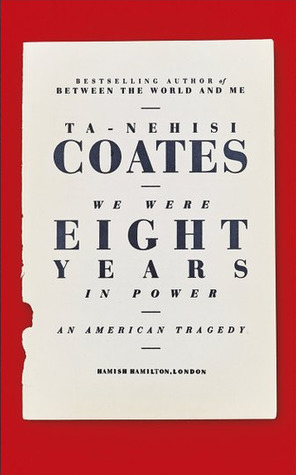
We Were Eight Years in Power by Ta-Nehisi Coates

I liked this book, but it was really hard to read. This is a collection of Ta-Nehisi Coates' previous essays written for The Atlantic. I had read them on his blog, but here they are expanded with new introductions to each article. These introductions, detailing Coates' state of mind while writing them, are invaluable. The essays form a picture of the meaning of Barack Obama's presidency, coming from the mind and pen of a gifted African-American man who has become one of this country's foremost writers on race.

That being the case, the epilogue of this book, a new essay titled "The First White President," was the equivalent of a body blow. Coates lays bear the election of the current horrid occupant of the White House as belonging both to the backlash against President Obama and a last-gasp effort to maintain white supremacy in this country. (And, as we've found out since, prodded along by Russian hackers, and the insane Republican obsession with Hillary Clinton and her husband.) This final essay is a downer, buoyed (if one can call it that) by the author's trademark pessimism. But that makes this book even more important, and I hope it will find its way into school classrooms as required reading on race in America.
The Fated Sky by Mary Robinette Kowal

This is the sequel to The Calculating Stars. I've read that the story was originally supposed to be all one book, but the author asked that it be split in two. This was an inspired decision, as I can't imagine trying to cram both stories into one book. Even the covers reflect the difference: blue for the first book and the launch to the moon, and red for this one and the First Mars Expedition.

Our core characters, the married couple Nathaniel and Elma York, engineer and human computer/astronaut respectively, return. Set in 1961, a decade after the first book, there is a thriving colony on the moon and training has begun for the mission to Mars. Elma is a self-described "glorified bus driver," shuttling people around on the moon. But there are rumblings on Earth, people denying the coming catastrophe of climate change after this alternate history's meteor strike (shades of today, minus the meteor), and to ward off the defunding of the space program, Elma York, the famous Lady Astronaut, is added to the Mars mission.

The First Mars Expedition is the focus of this book, spelled out in gritty, obviously highly-researched detail. If you've never thought through the nasty ramifications of an E. coli infection in space...let's just say this book will teach you many things. Mary Robinette Kowal captures perfectly the beauty and horror of space travel, the fragility of little tin boxes traveling 34 million miles to Mars, and the audacity of the human race to think they could even pull off such a thing.

One of the themes of the first book was 1950's sexism, and Elma's struggle to have herself and other women added to the astronaut program. Since this book is set in the early 60's, with this alternate history's Civil Rights Movement in full bloom, the focus here shifts to racism. Elma may be sensitive to double standards and sexist slights, but she's still a clueless white woman in terms of race, as the book aptly points out. There's some nice growth for Elma as well as the other characters, including Stetson Parker, a carryover from the first book. Stetson in particular is shown to be far more complex than he was given credit for, even though he's still quite the ass. And of course the heart of the series remains the mature, supportive relationship between Elma and Nathaniel, as the two of them decide not to have children so Elma can join the First Mars Expedition.

I just love both these books to pieces, and wholeheartedly recommend them. I've heard the author plans to write more in this series, and I can only say, Please! I will read them as fast as she puts them out.
Spinning Silver by Naomi Novik

Well, I've had a run of really good books lately, and this is yet another one.

I've followed Naomi Novik throughout her Temeraire alternate-history series (with dragons), and her Uprooted was one of my favorite books from a few years ago. Uprooted seemed to signal a new phase to her career, of expanding upon and retelling familiar (and not so familiar) fairy tales, and adding her own unique spin to them. Spinning Silver continues this tradition, as a very loose interpretation of Rumplestiltskin.

By far the strength of this book is the characters, with the lovely, evocative writing and the well-drawn setting close behind. There are three main viewpoint characters. The first, and the nominal protagonist, is Miryem, the moneylender's daughter who takes over the family business from her ineffectual father and whose real-world skill in turning a profit attracts the attention of the king of the Staryk, Novik's version of the Fae. Wanda is the poor daughter of a drunken father who just wants herself and her brothers to survive, and is drawn into Miryem's orbit in trying to pay off her father's debt. Finally, there is Irina, the daughter of a duke who is also a descendant, through her mother, of one of the Staryk, and who is a pawn in her father's attempts to ingratiate himself with the tsar of their country, Lithvas. Irina ends up unwillingly married to the same tsar, who unbeknownst to anyone, is possessed by a fire demon.

(There are also a few other viewpoint characters. This book is told in its entirety in first person, and there are no notations of POV switches, just line breaks. However, within a paragraph or two I knew who was narrating and where we were. This speaks highly to Naomi Novik's skill in characterization and plotting, to handle these POV changes so seamlessly.)

As you can see, each of these young women is being held down and oppressed, to one degree or another, by the men in her life, and all their arcs involve trying to free themselves. This book's other themes include duty and sacrifice, stepping up and taking responsibility, and the love of a found family as well as a born one. The pacing is measured and deliberate, especially in the beginning, but everything that might be construed as making the book "slow" becomes important in the end. And the prose is just so beautiful: you can feel the icy puffs of the Winter King's breath, and the silver coins slipping through Miryem's hands as she changes them to gold.

The only character I gave a bit of side-eye to is the king of the Staryk, who was a stubborn, prideful, arrogant ass, at least in the beginning. But that same stubborn pride, and his insistence on bargaining to get what he wants, is the thing that helps Miryem to grow and gives her the strength to defeat the enemy of the Staryk in the end. Even the designated "bad guy" (the tsar) has a revealed backstory that caused a few second thoughts, at least in this reader. This is just a lovely, magical book all the way around, and I highly recommend it.
Space Opera by Catherynne M. Valente

And my run of good books comes to a screeching halt.

That isn't really fair, I guess. I'm sure a lot of people like this book. Unfortunately, this book isn't for me. I tried to read it, but I had to give up about halfway through. Valente is a good writer, especially at shorter lengths, and I've read and liked things of hers previously, in particular The Refrigerator Monologues. But this book is so over the top that I felt exhausted trying to read it. I call the writing style for this book thesaurus vomitus, and it's just not something I can read for very long.

(For example, the first sentence of the book:

Once upon a time on a small, watery, excitable planet called Earth, in a small, watery, excitable country called Italy, a soft-spoken, rather nice-looking gentleman by the name of Enrico Fermi was born into a family so overprotective that he felt compelled to invent the atomic bomb.


The entire book is like this.)

Which is sad, because I think there might be a good story here, if I could get into it. From what I've read about the book, it's basically Eurovision (the annual European singing contest, which I've also never watched) in space. Which is why I suppose it's over the top, but that doesn't make it any less exhausting. I've struggled with this book for about a month, and I finally had to give it up. So if you like absurdist humor, paragraph-length sentences, and a stream-of-consciousness narrative, give this a try. I'm moving on to other things.
Before Mars by Emma Newman

I've read one of Emma Newman's books before, Planetfall, and I hated the ending. (Review here.) Because of this, I hesitated over bringing this book home from the library. I finally decided to take a chance on it, and I'm glad I did, as this is a stronger novel in every way.

These books (there is a second in the series, After Atlas, which I've yet to read) follow the same storyline but focus on different characters. The setting in this book is the Mars colony, Mars Principia (also the name of the colony's AI), and the characters are its inhabitants (five). Our main character is Anna Kubrin, the geologist/artist in residence, sent there by the corporation that owns and operates the colony. In this future, corporations have taken over the world's governments, and own (pretty much) the entire population of Earth. One's value as a human being depends on how high up one climbs in the gov-corp.

This story is a pretty neat little puzzle box of a mystery, with some very interesting things to say about motherhood, postpartum depression, and how society treats women who become mothers. Anna was basically tricked into having her one child (by her needy, egotistical little prick of a husband) and knows she does not love her daughter Mia as she thinks she should. It's a viewpoint I've rarely seen expressed in fiction, and a lot of it was apparently based on the author's real-life experience. Anna is a well-drawn character, with realistic flaws and depth. But there are also larger themes in this book, themes of privacy and human rights, and a chilling backstory where the gov-corps have destroyed democracy. All these things come to a climax in a stunning plot twist about three-fourths of the way through the book, and the aftermath deals with Anna and her fellow colonists picking up the pieces and going on.

This book is a little bit on the nose with the current world climate, and as such is not a comfortable read. But it ends with a tiny, fragile hope for the future. Highly recommended.


November 2020

M T W T F S S
      1
2345678
9101112131415
16171819202122
232425262728 29
30      

Words To Live By

There is no frigate like a book to take us lands away. ~Emily Dickinson

Being a writer is a very peculiar sort of a job: it’s always you versus a blank sheet of paper (or a blank screen) and quite often the blank piece of paper wins. ~Neil Gaiman

Of course I am not worried about intimidating men. The type of man who will be intimidated by me is exactly the type of man I have no interest in. ~Chimamanda Ngozi Adichie

The road to hell is paved with adverbs. ~Stephen King

The man who does not read has no advantage over the man who cannot read. ~Mark Twain

I feel free and strong. If I were not a reader of books I could not feel this way. ~Walter Tevis

A reader lives a thousand lives before he dies. The man who never reads lives only one. ~George R.R. Martin

Most Popular Tags

Style Credit

Page generated May. 14th, 2026 11:04 pm
Powered by Dreamwidth Studios